Trigonometry
Help Questions
ACT Math › Trigonometry
If 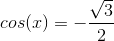


Explanation
Based on this data, we can make a little triangle that looks like:
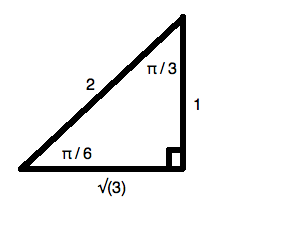
This is because 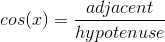
Now, this means that 
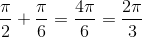


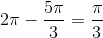
Looking at our little triangle above, we can see that the cosine of 

What is the period of the function 


Explanation
To find the period of Sine and Cosine functions you use the formula:




Given a function 


Explanation
The function 

The domain of the parent function is 


The answer is 
Find the domain of 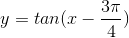




Explanation
The domain of 


The ends of every period approaches to either positive or negative infinity. Notice that for this problem, the entire graph shifts to the right 
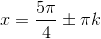
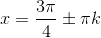
The asymptotes will exist at:

Therefore, the domain of 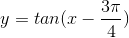

Given a function
Explanation
The function
The domain of the parent function is
The answer is
Using trig identities, simplify sinθ + cotθcosθ
tanθ
secθ
sin2θ
cos2θ
cscθ
Explanation
Cotθ can be written as cosθ/sinθ, which results in sinθ + cos2θ/sinθ.
Combining to get a single fraction results in (sin2θ + cos2θ)/sinθ.
Knowing that sin2θ + cos2θ = 1, we get 1/sinθ, which can be written as cscθ.
A man has a rope that is 


Explanation
Begin by drawing out this scenario using a little right triangle:

We know that the cosine of an angle is equal to the ratio of the side adjacent to that angle to the hypotenuse of the triangle. Thus, for our triangle, we know:

Using your calculator, solve for 

This is 

Thus, rounded, your answer is 

A man has a rope that is
Explanation
Begin by drawing out this scenario using a little right triangle:
We know that the cosine of an angle is equal to the ratio of the side adjacent to that angle to the hypotenuse of the triangle. Thus, for our triangle, we know:
Using your calculator, solve for
This is
Thus, rounded, your answer is
Given a function
Explanation
The function
The domain of the parent function is
The answer is
Find the domain of
Explanation
The domain of
The ends of every period approaches to either positive or negative infinity. Notice that for this problem, the entire graph shifts to the right
The asymptotes will exist at:
Therefore, the domain of