Chemical Equilibrium
Help Questions
AP Chemistry › Chemical Equilibrium

Figure 1: Ammonia gas formation and equilibrium
Experimental data shows that the reaction shifts to the left at very cold temperatures. Using this information, what type of reaction is shown in Figure 1?
Endothermic
Exothermic
Endergonic
Exergonic
Boltzmann-like
Explanation
This is an application of Le Chatlier's Principle. When you take away heat from the reaction, the reaction shifts toward the left in order to compensate from the heat loss. The reaction may then be rewritten to include energy as a reactant.

Since the energy is on the reactant side, the reaction is endothermic.
According to Le Chatelier's principle, which of the following occurs when you compress a system containing at least one gas species?
shifts to favor the side with less moles of gas
shifts to favor the side with more moles of gas
remains at equilibrium
not enough information to determine
Explanation
According to Le Chatelier's principle, when you compress a system, its volume decreases, so partial pressure of the all the gases in the system increases. The system will act to try to decrease the pressure by decreasing the moles of gas.

Self-ionization of water is endothermic. What is the value of the sum pH + pOH at 
Less than 14
Equal to 14
Greater than 14
It is impossible to determine without more information
Explanation
Recall that ion-product constant of water, 



An endothermic reaction signifies that heat is at the reactant side. By the LeChatelier's principle, increased heat to 


Self-ionization of water is endothermic. What is the value of the sum pH + pOH at
Less than 14
Equal to 14
Greater than 14
It is impossible to determine without more information
Explanation
Recall that ion-product constant of water,
An endothermic reaction signifies that heat is at the reactant side. By the LeChatelier's principle, increased heat to
Which of the following stresses would lead the exothermic reaction below to shift to the right?

Increasing \[A\]
Increasing \[C\]
Increasing the temperature
Decreasing the volume
Explanation
By increasing the concentration of one of the reactants, the reaction will compensate by shifting to the right to increase production of products.
Increasing the concentration of one of the products (such as increasing \[C\]), however, would have the opposite effect. Increasing the temperature of an exothermic reaction would shift the reaction to the left, while increasing the temperature of an endothermic reaction would lead to a rightward shift. Finally, decreasing the volume leads to an increase in partial pressure of each gas, which the system compensates for by shifting to the side with fewer moles of gas. In this case, the right side has three moles of gas, while the left side has two; thus decreasing volume would shift equilibrium to the left.
According to Le Chatelier's principle, which of the following occurs when you compress a system containing at least one gas species?
shifts to favor the side with less moles of gas
shifts to favor the side with more moles of gas
remains at equilibrium
not enough information to determine
Explanation
According to Le Chatelier's principle, when you compress a system, its volume decreases, so partial pressure of the all the gases in the system increases. The system will act to try to decrease the pressure by decreasing the moles of gas.
Figure 1: Ammonia gas formation and equilibrium
Experimental data shows that the reaction shifts to the left at very cold temperatures. Using this information, what type of reaction is shown in Figure 1?
Endothermic
Exothermic
Endergonic
Exergonic
Boltzmann-like
Explanation
This is an application of Le Chatlier's Principle. When you take away heat from the reaction, the reaction shifts toward the left in order to compensate from the heat loss. The reaction may then be rewritten to include energy as a reactant.
Since the energy is on the reactant side, the reaction is endothermic.
Which of the following stresses would lead the exothermic reaction below to shift to the right?
Increasing \[A\]
Increasing \[C\]
Increasing the temperature
Decreasing the volume
Explanation
By increasing the concentration of one of the reactants, the reaction will compensate by shifting to the right to increase production of products.
Increasing the concentration of one of the products (such as increasing \[C\]), however, would have the opposite effect. Increasing the temperature of an exothermic reaction would shift the reaction to the left, while increasing the temperature of an endothermic reaction would lead to a rightward shift. Finally, decreasing the volume leads to an increase in partial pressure of each gas, which the system compensates for by shifting to the side with fewer moles of gas. In this case, the right side has three moles of gas, while the left side has two; thus decreasing volume would shift equilibrium to the left.
Consider the following balanced reaction.

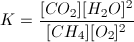
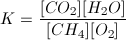
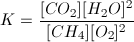
Write the equilibrium constant expression for this reaction.


Explanation
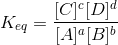
When writing an equilibrium constant expression, remember that products are on the top, and reactants are on the bottom of the expression. The coefficients for the compounds in the balanced reaction become the exponents for the compounds seen in the expression.


Which of the following is true when the reaction quotient (Q) equals the equilibrium constant (K)?
Change in free energy = 0.
The change in free energy is greater than zero.
The change in free energy is less than zero.
The reaction stops completely.
Explanation
When Q = K, the reaction has reached equilibrium and is in a state of dynamic equilibrium, where the forward and reverse reactions are occurring at the same rate. Since there is no net change in concentration, the free energy is zero.