Random Variables
Help Questions
AP Statistics › Random Variables
Which of the following is a discrete random variable?
The number of times heads comes up on 10 coin flips
The amount of water that passes through a dam in a random hour
The rate of return on a random stock investment
The length of a random caterpillar
Explanation
A discrete variable is a variable which can only take a countable number of values. For example, the number of times that a coin can come up heads in ten flips can only be 0, 1, 2, 3, 4, 5, 6, 7, 8, 9, or 10. Thus, there are a countable number of possible outcomes (in this case 11). This is true for coin flips, but not for caterpillar length, water flow, or rates of return for stocks.
Which of the following is a discrete random variable?
The number of times heads comes up on 10 coin flips
The amount of water that passes through a dam in a random hour
The rate of return on a random stock investment
The length of a random caterpillar
Explanation
A discrete variable is a variable which can only take a countable number of values. For example, the number of times that a coin can come up heads in ten flips can only be 0, 1, 2, 3, 4, 5, 6, 7, 8, 9, or 10. Thus, there are a countable number of possible outcomes (in this case 11). This is true for coin flips, but not for caterpillar length, water flow, or rates of return for stocks.
If you flip a biased coin, which has a 


Explanation
To calculate this probability, we need to calculate the chance of getting 4 tails and then a head.
Each tail has a prob. of 


So the probability is

If 


Explanation
If the random variables are independent, the variances are additive in the sense that

So then the variance of the sum is

The standard deviation is the square root of the variance, so we have

If
Explanation
If the random variables are independent, the variances are additive in the sense that
So then the variance of the sum is
The standard deviation is the square root of the variance, so we have
If you flip a biased coin, which has a
Explanation
To calculate this probability, we need to calculate the chance of getting 4 tails and then a head.
Each tail has a prob. of
So the probability is
Suppose you are throwing three darts and you have a one third chance of hitting the bull's eye. Each throw is independent of one another. What is the chance of hitting the bull's eye at least once?


Explanation
To calculate Prob(at least one bull's eye), we can instead compute one minus the complementary probability, P(no bull's eye).
So we have P(at least one bull's eye)=1-P(no bull's eye).
The chance of getting no bull's eyes is 
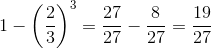
This means the probability of getting at least one bull's eye is
Let us suppose you are a waiter. You work your first four shifts and receive the following in tips: (1) 20, (2) 30, (3) 15, (4) 5. What is the mean amount of tips you will receive in a given day?


Explanation
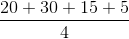
The answer is 17.5. Simply take the values for each day, add them, and divide by the total number of days to obtain the mean:
Let us suppose you are a waiter. You work your first four shifts and receive the following in tips: (1) 20, (2) 30, (3) 15, (4) 5. What is the mean amount of tips you will receive in a given day?
Explanation
The answer is 17.5. Simply take the values for each day, add them, and divide by the total number of days to obtain the mean:
Suppose you are throwing three darts and you have a one third chance of hitting the bull's eye. Each throw is independent of one another. What is the chance of hitting the bull's eye at least once?
Explanation
To calculate Prob(at least one bull's eye), we can instead compute one minus the complementary probability, P(no bull's eye).
So we have P(at least one bull's eye)=1-P(no bull's eye).
The chance of getting no bull's eyes is
This means the probability of getting at least one bull's eye is