Operations in Expressions
Help Questions
Basic Math › Operations in Expressions
Factor the following expression:


Explanation
When you factor an expression, you are separating it into its basic parts. When you multiply those parts back together, you should obtain the original expression.
The first step when factoring an expression is to see if all of the terms have something in common. In this case, 


The next step is to focus on what's in the parentheses. To factor an expression of form 


We've found our factors! We can therefore factor what's inside the parentheses, 


Factor


Explanation
To factor an equation in the form 


List the factors of 36 and add them together:


Since 


Factor
Explanation
To factor an equation in the form
List the factors of 36 and add them together:
Since
Solve:



Explanation
Use the order of operations: PEMDAS (Parentheses, Exponents, Multiplication, Division, Addition, Subtraction).
We want to solve what's in the parentheses first.


Now, do the division and the multiplication.


Therefore our equation becomes:

Finally, subtract.

Factor the following expression:
Explanation
When you factor an expression, you are separating it into its basic parts. When you multiply those parts back together, you should obtain the original expression.
The first step when factoring an expression is to see if all of the terms have something in common. In this case,
The next step is to focus on what's in the parentheses. To factor an expression of form
We've found our factors! We can therefore factor what's inside the parentheses,
Solve:
Explanation
Use the order of operations: PEMDAS (Parentheses, Exponents, Multiplication, Division, Addition, Subtraction).
We want to solve what's in the parentheses first.
Now, do the division and the multiplication.
Therefore our equation becomes:
Finally, subtract.
Simplify the following expression:


Explanation
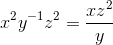
The correct answer is 
First we can start by simplifying the 'x' terms. We start with 


Now we can simplify the 'y' terms as follows: 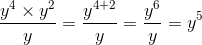
Last, the 'z' terms can be simplified as follows: 
This leaves us with the final simplified answer of 
Simplify



Explanation
We start with what is inside the parentheses, so 

Next, we take care of any exponents, giving us 
Next, we take care of multiplication/division, giving us 

Finally, we carry out our addition/subtraction, leaving us with 
Simplify the following expression:
Explanation
The correct answer is
First we can start by simplifying the 'x' terms. We start with
Now we can simplify the 'y' terms as follows:
Last, the 'z' terms can be simplified as follows:
This leaves us with the final simplified answer of
Simplify:


Explanation
When dividing terms with the same bases, remember to subtract the exponents.
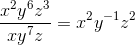
Keep in mind that when there is a negative exponent in the numerator, putting that term in the denominator will make the exponent positive.