Sectors
Help Questions
GMAT Quantitative › Sectors
What percentage of a circle is a sector if the angle of the sector is 


Explanation
The full measure of a circle is 



A given sector covers 


Explanation
A circle comprises 


Therefore:

What is the arc length for a sector with a central angle of 


Explanation
Using the formula for arc length, we can plug in the given angle and radius to calculate the length of the arc that subtends the central angle of the sector. The angle, however, must be in radians, so we make sure to convert degrees accordingly by multiplying the given angle by 


The arc 


Explanation
Examine the figure below, which shows the arc and chord in question.

If we extend the figure to depict the circle as the composite of four quarter-circles, each a 


is a diameter of this circle. The circumference is 

Since a 


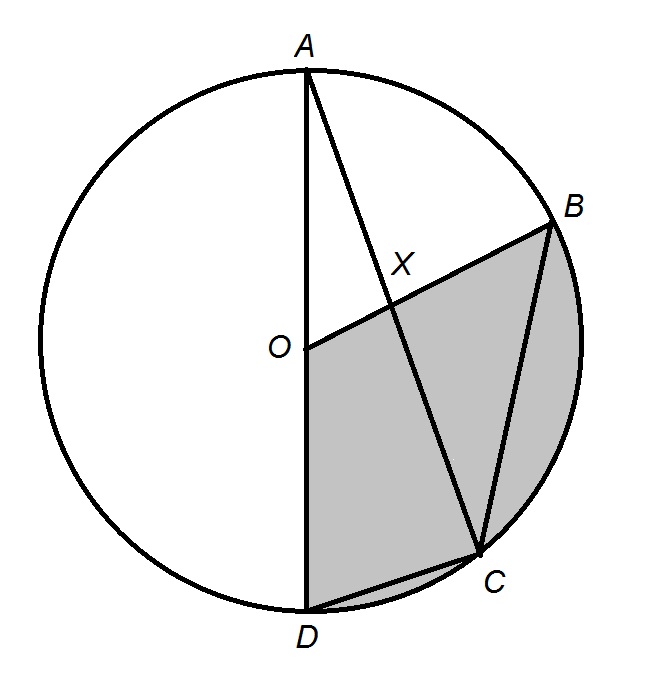
The circle in the above diagram has center 
Statement 1: Arc 

Statement 2: Arc 

BOTH statements TOGETHER are sufficient to answer the question, but NEITHER statement ALONE is sufficient to answer the question.
Statement 1 ALONE is sufficient to answer the question, but Statement 2 ALONE is NOT sufficient to answer the question.
EITHER statement ALONE is sufficient to answer the question.
Statement 2 ALONE is sufficient to answer the question, but Statement 1 ALONE is NOT sufficient to answer the question.
BOTH statements TOGETHER are insufficient to answer the question.
Explanation
Assume Statement 1 alone. Since the circumference of the circle is not given, it cannot be determined what part of the circle 
Now assume both statements are true. Then the length of semicircle 






A teacher buys a supersized pizza for his after-school club. The super-pizza has a diameter of 18 inches. If the teacher is able to perfectly cut from the center a 36 degree sector for himself, what is the area of his slice of pizza, rounded to the nearest square inch?
25
24
28
26
27
Explanation
First we calculate the area of the pizza. The area of a circle is defined as 

Since the sector of the pie he cut for himself is 36 degrees, we can set up a ratio to find how much of the pizza he cut for himself. Let x be the area of the pizza he cut for himself. Then we know,
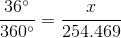
Solving for x, we get x=25.45 square inches, which rounds down to 25.
A given sector of a circle comprises 


Explanation
A circle comprises 


Therefore:

What percentage of a circle's total area is covered by a sector with an angle of 


Explanation
The full measure of a circle is 



A giant clock has a minute hand that is eight feet long. The time is now 2:40 PM. How far has the tip of the minute hand moved, in inches, between noon and now?


Explanation
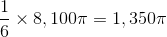
Between noon and 2:40 PM, two hours and forty minutes have elapsed, or, equivalently, two and two-thirds hours. This means that the minute hand has made 
In one revolution, the tip of an eight-foot minute hand moves 

After 

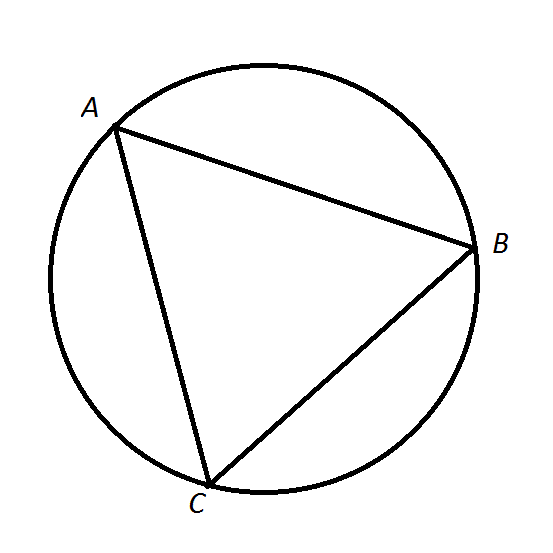
Note: Figure NOT drawn to scale.

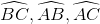
Order the degree measures of the arcs 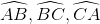

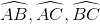
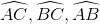
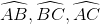
Explanation



The degree measure of an arc is twice that of the inscribed angle that intercepts it, so the above can be rewritten as
