Other Quadrilaterals
Help Questions
GMAT Quantitative › Other Quadrilaterals

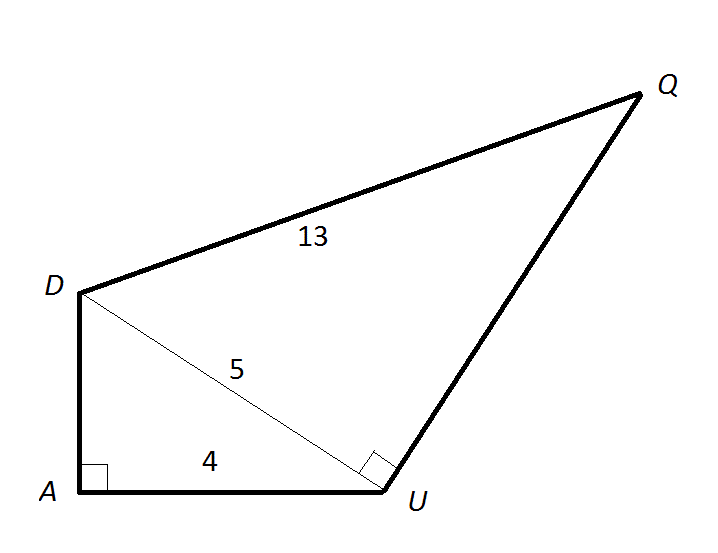
Note: Figure NOT drawn to scale.
Refer to the above diagram. Give the area of Quadrilateral 

The correct answer is not among the other choices.


Explanation
Apply the Pythagorean Theorem twice here.


The quadrilateral is a composite of two right triangles, each of whose area is half the product of its legs:
Area of 

Area of 

Add:


Note: Figure NOT drawn to scale.
The above figure is of a rhombus and one of its diagonals. What is 


Not enough information is given to answer the question.
Explanation
The four sides of a rhombus are congruent, so a diagonal of the rhombus cuts it into two isosceles triangles. The two angles adjacent to the diagonal are congruent, so the third angle, the one marked, measures:

Two angles of a parallelogram measure 


Explanation
Case 1: The two angles are opposite angles of the parallelogram. In this case, they are congruent, and


Case 2: The two angles are consecutive angles of the parallelogram. In this case, they are supplementary, and


Note: Figure NOT drawn to scale
What is the area of Quadrilateral 


Explanation
Quadrilateral 


By the Pythagorean Theorem:


Also by the Pythagorean Theorem:


The area of 

The area of 

Add the areas to get 

What is the area of a trapezoid with a height of 7, a base of 5, and another base of 13?


Explanation

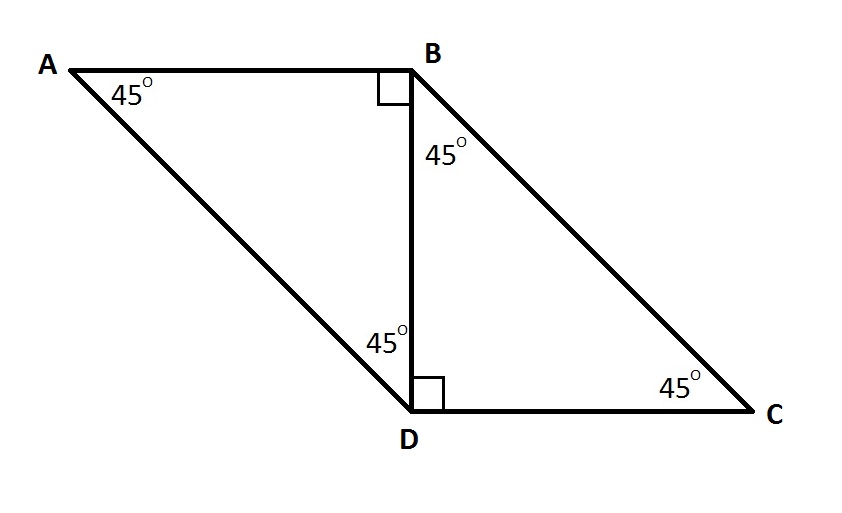
Give the area of the above parallelogram if 


Explanation
Multiply height 

By the 45-45-90 Theorem,

Since the product of the height and the base of a parallelogram is its area,


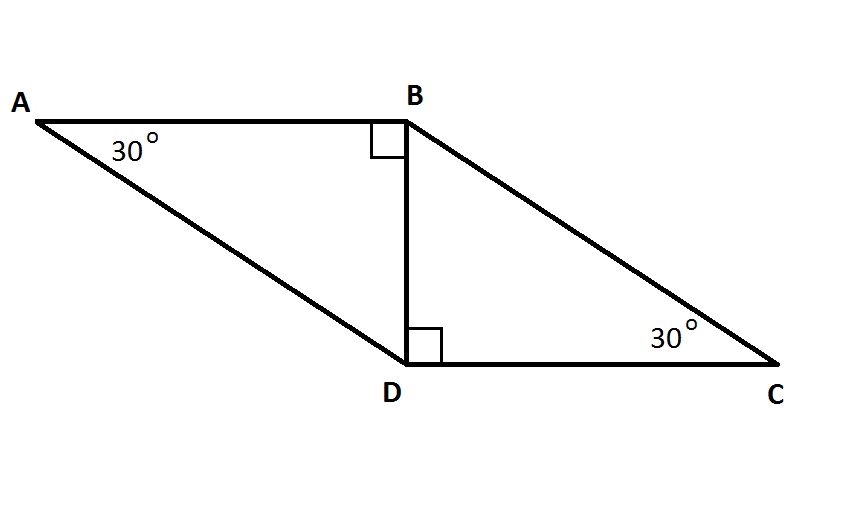
Give the area of the above parallelogram if 


Explanation
Multiply height
By the 30-60-90 Theorem:


The area is therefore


The above figure shows a rhombus 


Explanation
Construct the other diagonal of the rhombus, which, along with the first one, form a pair of mutual perpendicular bisectors.

By the Pythagorean Theorem,

The rhombus can be seen as the composite of four congruent right triangles, each with legs 10 and 

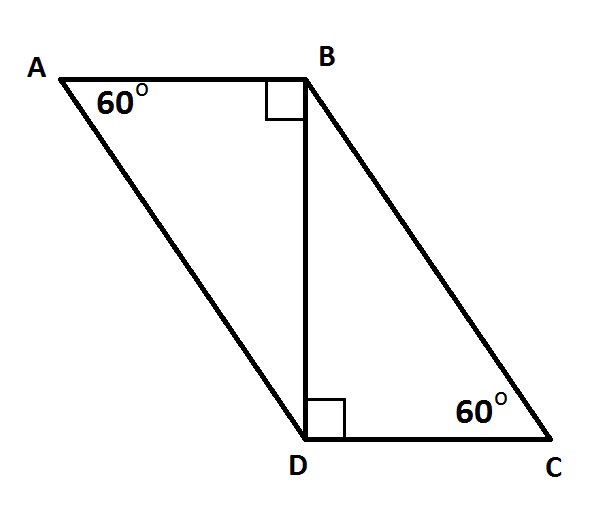
Give the area of the above parallelogram if 


Explanation
Multiply height
By the 30-60-90 Theorem:


The area is therefore

What is the area of the quadrilateral on the coordinate plane with vertices 


Explanation
The quadrilateral is a parallelogram with two vertical bases, each with length 


