Specific Derivatives
Help Questions
Math › Specific Derivatives
What is the first derivative of 




Explanation
Since we're adding terms, we take the derivative of each part separately. For 
Remember, 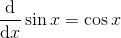


What is the first derivative of
Explanation
Since we're adding terms, we take the derivative of each part separately. For
Remember,
Give the instantaneous rate of change of the function 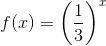


Explanation
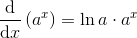
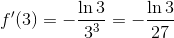
The instantaneous rate of change of 




What is the second derivative of 


Explanation
To find the second derivative, we need to start by finding the first one.
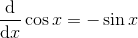
Since we're adding terms, we take the derivative of each part separately. For 
Remember, 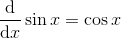


Now we repeat the process, but using 


Give the instantaneous rate of change of the function
Explanation
The instantaneous rate of change of
What is the second derivative of
Explanation
To find the second derivative, we need to start by finding the first one.
Since we're adding terms, we take the derivative of each part separately. For
Remember,
Now we repeat the process, but using
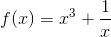
Find the derivative of the following function:
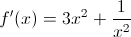
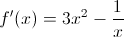


Explanation
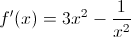
Since this function is a polynomial, we take the derivative of each term separately.
From the power rule, the derivative of

is simply

We can rewrite 

and using the power rule again, we get a derivative of


So the answer is
Find the derivative of the following function:
Explanation
Since this function is a polynomial, we take the derivative of each term separately.
From the power rule, the derivative of
is simply
We can rewrite
and using the power rule again, we get a derivative of
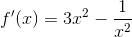
So the answer is


Explanation
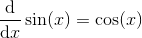
The derivative of a sine function does not follow the power rule. It is one that should be memorized.
Explanation
The derivative of a sine function does not follow the power rule. It is one that should be memorized.