Circles
Help Questions
Math › Circles
Find the area of a circle that has a radius of 


Explanation
Use the following formula to find the area of a circle:

For the circle in question, plug in the given radius to find the area.
We know the radius is 

Recall that when a square root is squared you are left with the number under the square root sign. This happens because when you square a number you are multiplying it by itself. In our case this is,

From here we can use the property of multiplication and radicals to rewrite our expression as follows,

and when there are two numbers that are the same under a square root sign you bring out one and the other number and square root sign go away.

If the diameter of the circle below is 


Explanation

From the given figure, you should notice that the base of the triangle is the same as the diameter of the circle.
In order to find the area of the shaded region, we will first need to find the area of the circle and the area of the triangle.
Recall how to find the area of a circle:

Now recall the relationship between the radius and the diameter.

Plug in the value of the diameter to find the value of the radius.

Now, plug in the value of the radius in to find the area of the circle.

Next, recall how to find the area of a triangle.

The height is already given by the question, and remember that the base is the same as the diameter of the circle.
Plug in these values to find the area of the triangle.

We are now ready to find the area of the shaded region.


Remember to round to 
Find the area of the sector that has a central angle of 


Explanation
The circle in question can be drawn as shown by the figure below:

Since the area of a sector is just a fractional part of the area of a circle, we can write the following equation to find the area of a sector:


Plug in the given central angle and radius to find the area of the sector.

Make sure to round to two places after the decimal.
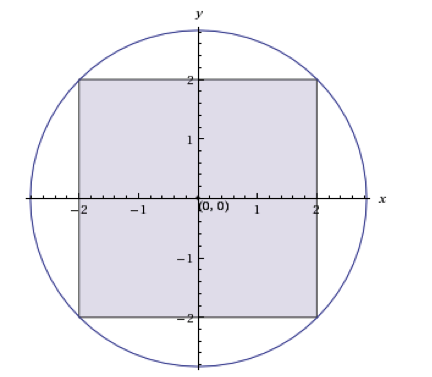
A square with a side length of 4 inches is inscribed in a circle, as shown below. What is the area of the unshaded region inside of the circle, in square inches?
8π - 16
4π-4
8π-4
2π-4
8π-8
Explanation
Using the Pythagorean Theorem, the diameter of the circle (also the diagonal of the square) can be found to be 4√2. Thus, the radius of the circle is half of the diameter, or 2√2. The area of the circle is then π(2√2)2, which equals 8π. Next, the area of the square must be subtracted from the entire circle, yielding an area of 8π-16 square inches.
The circumferences of eight circles form an arithmetic sequence. The smallest circle has radius two inches; the second smallest circle has radius five inches. Give the radius of the largest circle.
1 foot, 11 inches
2 feet
2 feet, 1 inch
4 feet 2 inches
3 feet 10 inches
Explanation
The circumference of a circle can be determined by multiplying its radius by 

and

The circumferences form an arithmetic sequence with common difference

The circumference of a circle can therefore be found using the formula

where 






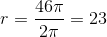
Since the radius of a circle is the circumference of the circle divided by 
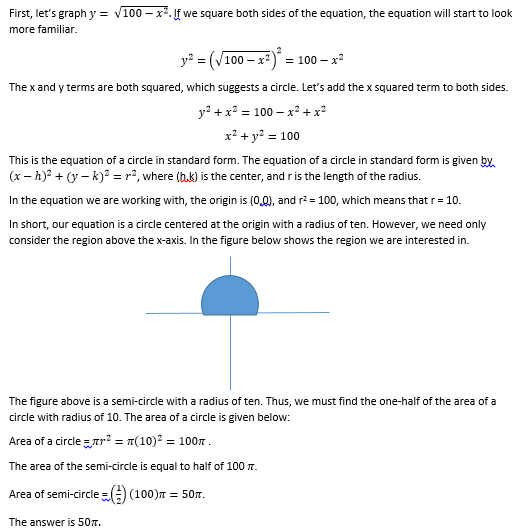
Find the area of a circle that has a radius of
Explanation
Use the following formula to find the area of a circle:
For the circle in question, plug in the given radius to find the area.
We know the radius is
Recall that when a square root is squared you are left with the number under the square root sign. This happens because when you square a number you are multiplying it by itself. In our case this is,
From here we can use the property of multiplication and radicals to rewrite our expression as follows,
and when there are two numbers that are the same under a square root sign you bring out one and the other number and square root sign go away.

100_π_
50_π_
25_π_
10_π_
20_π_
Explanation
In the figure below,


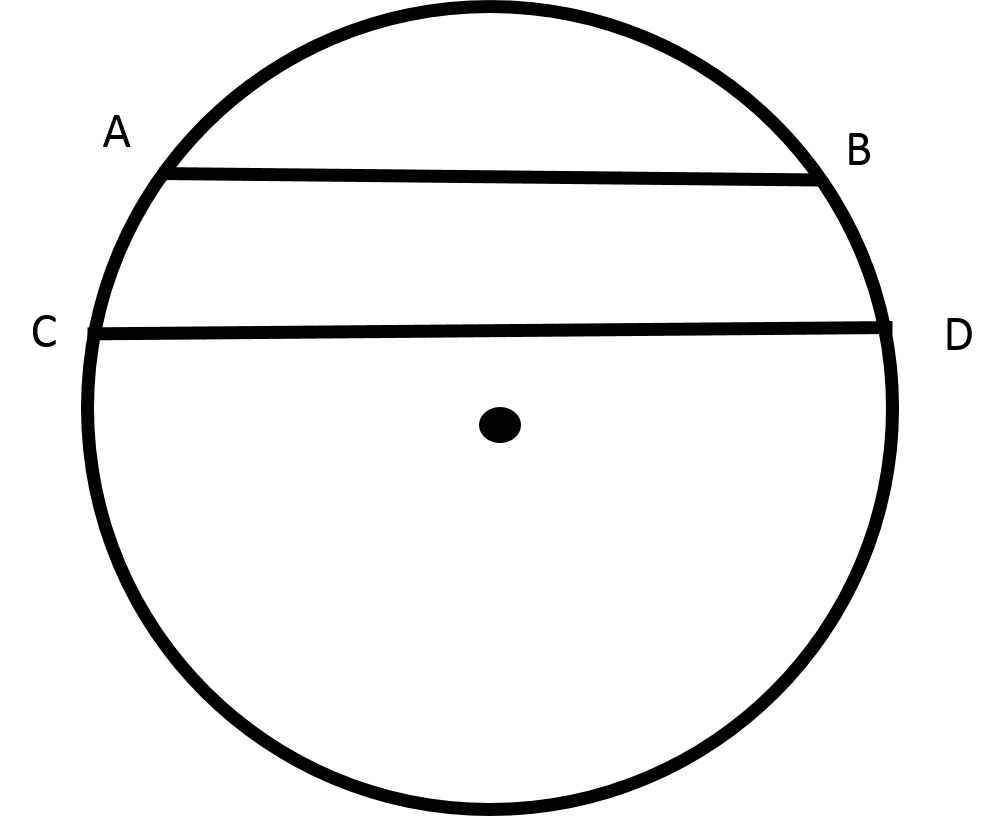


The measurement of 
Explanation
Recall that when chords are parallel, the arcs that are intercepted are congruent. Thus, 
Then, 

If the diameter of the circle below is
Explanation
From the given figure, you should notice that the base of the triangle is the same as the diameter of the circle.
In order to find the area of the shaded region, we will first need to find the area of the circle and the area of the triangle.
Recall how to find the area of a circle:
Now recall the relationship between the radius and the diameter.
Plug in the value of the diameter to find the value of the radius.
Now, plug in the value of the radius in to find the area of the circle.
Next, recall how to find the area of a triangle.
The height is already given by the question, and remember that the base is the same as the diameter of the circle.
Plug in these values to find the area of the triangle.
We are now ready to find the area of the shaded region.
Remember to round to
A sector in a circle with a radius of 


Explanation
Recall how to find the area of a sector:

Since the question asks for the measurement of the central angle, rearrange the equation like thus:

Plug in the given information to find the measurement of the central angle.

The central angle is 