Cylinders
Help Questions
Math › Cylinders
Find the surface area of the given cylinder.


Explanation
To find the surface area of the cylinder, first find the areas of the bases:

Next, find the lateral surface area, which is a rectangle:

Add the two together to get the equation to find the surface area of a cylinder:

Plug in the given height and radius to find the surface area.

Make sure to round to 
What is the surface area of a cylinder of height 


Explanation
Recall that to find the surface area of a cylinder, you need to find the surface area of its two bases and then the surface area of its "outer face." The first two are very easy since they are circles. The equation for one base is:

For our problem, this is:

You need to double this for the two bases:

The area of the "outer face" is a little bit trickier, but it is not impossible. It is actually a rectangle that has the height of the cylinder and a width equal to the circumference of the base; therefore, it is:

For our problem, this is:

Therefore, the total surface area is:

Find the surface area of the given cylinder.
Explanation
To find the surface area of the cylinder, first find the areas of the bases:
Next, find the lateral surface area, which is a rectangle:
Add the two together to get the equation to find the surface area of a cylinder:
Plug in the given height and radius to find the surface area.
Make sure to round to
What is the volume of a cylinder with a radius of 6 meters and a height of 11 meters? Use 3.14 for 
Note: The formula for the volume of a cylinder is:


Explanation
To calculate the volume, you must plug into the formula given in the problem. When you plug in, it should look like this: 

What is the surface area of a cylinder with a radius of 2 cm and a height of 10 cm?
40π cm2
32π cm2
56π cm2
48π cm2
36π cm2
Explanation
SAcylinder = 2πrh + 2πr2 = 2π(2)(10) + 2π(2)2 = 40π + 8π = 48π cm2
What is the volume of a hollow cylinder with an outer diameter of 


Explanation
The general formula for the volume of a hollow cylinder is given by 


The question gives diameters and we need to convert them to radii by cutting the diameters in half. Remember, 


What is the volume of a hollow cylinder with an outer diameter of
Explanation
The general formula for the volume of a hollow cylinder is given by
The question gives diameters and we need to convert them to radii by cutting the diameters in half. Remember,
What is the surface area of a cylinder with a base diameter of 


None of the answers
Explanation
Area of a circle

Circumference of a circle

Surface area of a cylinder

The volume of a cylinder is 


Explanation
The volume of a cylinder is equal to:

Use this formula and the given radius to solve for the height.



Now that we know the height, we can solve for the surface area. The surface area of a cylinder is equal to the area of the two bases plus the area of the outer surface. The outer surface can be "unwrapped" to form a rectangle with a height equal to the cylinder height and a base equal to the circumference of the cylinder base. Add the areas of the two bases and this rectangle to find the total area.


Use the radius and height to solve.



Given a cylinder with radius of 5cm and a height of 10cm, what is the surface area of the entire cylinder?


Explanation
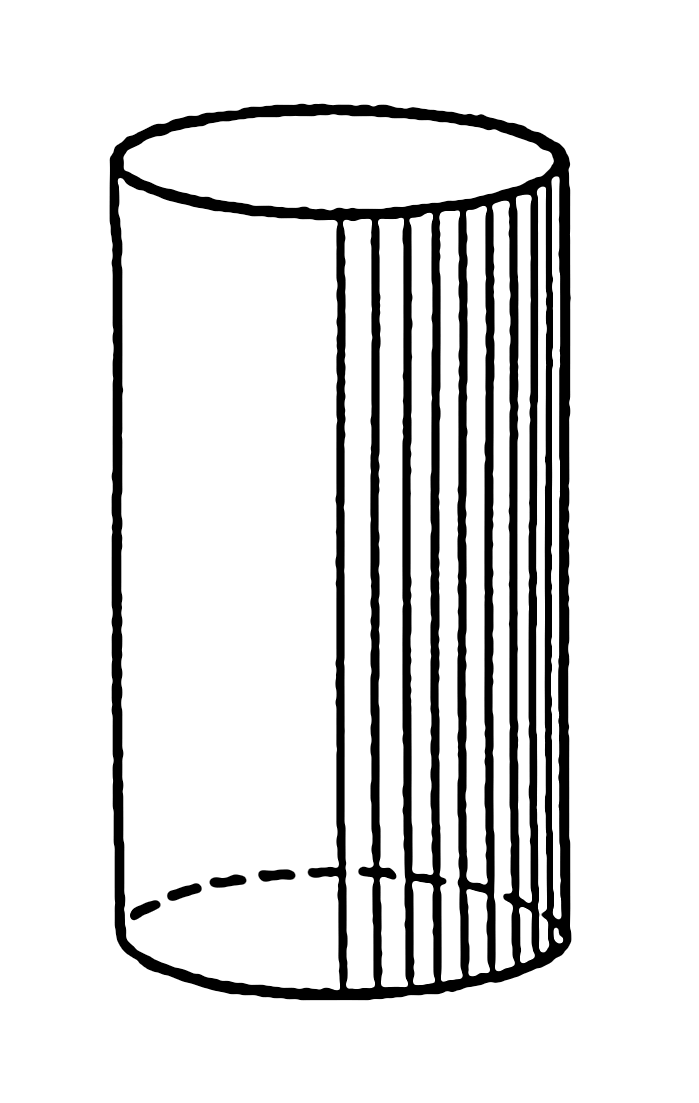
The surface area of the whole cylinder = (2 * area of circle) + lateral area
Think of the lateral area as the paper label on a can; It wraps around the outside of the can while leaving the top and bottom untouched. The area of the circle, times 2, is to account for the top and the bottom of the cylinder.
Area of a circle =

So the area of the circle = 


Now for the lateral area. Notice how if we have a can with a paper label, we can take the label, cut it, and unroll it from the can. In this way, our label now looks like a rectangle with a
height = height and the
width = circumference of the circle.
Circumference =

So our rectangle is going to have a height of 10 and a width of 10

So the total surface area =
