Stoichiometry
Help Questions
AP Chemistry › Stoichiometry
What volume of 0.5M NaOH is necessary to neutralize 15mL of 1.0M nitrous acid?
30mL
10mL
30L
1L
Explanation
Both the acid and the base provide one equivalent of the necessary ions (H+ and OH–, respectively) and therefore you can use the equation M1V1 = M2V2.
(1)(15) = (0.5)V2
V2 = 30mL
How many centimeters are in 14.1 inches?



Explanation

Remember, there are 2.54 centimeters in every one inch. 2.54 can be multiplied by the given number of inches in order to cancel units, and convert the inches to centimeters. Answer with the same number of significant figures, as what was given in the initial number.
How many centimeters are in 14.1 inches?
Explanation
Remember, there are 2.54 centimeters in every one inch. 2.54 can be multiplied by the given number of inches in order to cancel units, and convert the inches to centimeters. Answer with the same number of significant figures, as what was given in the initial number.
What volume of 0.5M NaOH is necessary to neutralize 15mL of 1.0M nitrous acid?
30mL
10mL
30L
1L
Explanation
Both the acid and the base provide one equivalent of the necessary ions (H+ and OH–, respectively) and therefore you can use the equation M1V1 = M2V2.
(1)(15) = (0.5)V2
V2 = 30mL
You may have heard the famous story of Archimedes and the golden crown; where the ancient Greek mathematician was challenged to determine if his King's golden crown was truly made of 100% gold. In that story Archimedes used density to determine that the crown was not 100% gold.
The density of gold is

In real life there are many applications for this concept that you can use in real life. For example lets say that you are in the business of selling scrap metal. You have spent a lot of time collecting a yellowish metal; but have no clue what it is, and don't wish to simply trust the judgment of the scrap metal buyer. You do know that the most likely yellow metals; given your sources for the metal are copper, brass and gold. You just don't know which it is by looking at it.
The density of copper is

The density of brass is 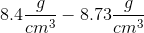
You have a scale and know the weight of your collected metal to be 20lbs. You take a container with water filling it to an initial volume of 40gal
Then you place your metal in the container, and the volume rises to 61.3gal. What is the identity of your metal?
1gal = 3.785L
1lb = 453.592g
Copper
Brass
Gold
None of these
Steel
Explanation
We know the following relationships from the information in the problem and from the definitions of the units:




Solving the problem:
The change in volume after you submerge your metal in the container is the volume of the metal itself. Therefore:

Since the densities we have been given are all expressed as 


Now that we have both the mass and volume of our unknown metal you can calculate the density of the metal because density is defined as:
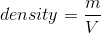
So the density of our metal is
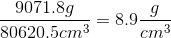
Since our metal's density matches the density of copper we can now prove that the metal is pure copper.
You may have heard the famous story of Archimedes and the golden crown; where the ancient Greek mathematician was challenged to determine if his King's golden crown was truly made of 100% gold. In that story Archimedes used density to determine that the crown was not 100% gold.
The density of gold is
In real life there are many applications for this concept that you can use in real life. For example lets say that you are in the business of selling scrap metal. You have spent a lot of time collecting a yellowish metal; but have no clue what it is, and don't wish to simply trust the judgment of the scrap metal buyer. You do know that the most likely yellow metals; given your sources for the metal are copper, brass and gold. You just don't know which it is by looking at it.
The density of copper is
The density of brass is
You have a scale and know the weight of your collected metal to be 20lbs. You take a container with water filling it to an initial volume of 40gal
Then you place your metal in the container, and the volume rises to 61.3gal. What is the identity of your metal?
1gal = 3.785L
1lb = 453.592g
Copper
Brass
Gold
None of these
Steel
Explanation
We know the following relationships from the information in the problem and from the definitions of the units:
Solving the problem:
The change in volume after you submerge your metal in the container is the volume of the metal itself. Therefore:
Since the densities we have been given are all expressed as
Now that we have both the mass and volume of our unknown metal you can calculate the density of the metal because density is defined as:
So the density of our metal is
Since our metal's density matches the density of copper we can now prove that the metal is pure copper.
What volume of chlorine gas at 


There is not enough information to answer this question
Explanation

First, we need to solve for the moles of chlorine gas needed to react with the full amount of sodium metal.

Now, using the ideal gas law, we can solve for the volume that this gas would occupy at the given temperature and pressure.





Consider the following chemical reaction:

How many moles of 
1.39mol
4.17mol
1.56 moles
There is not enough information to answer this question
None of the available answers
Explanation

This problem is solved based on stoichiometry. Using the molecular weights and ratios in the given reaction, we can solve for the amount of 
What volume of chlorine gas at
There is not enough information to answer this question
Explanation
First, we need to solve for the moles of chlorine gas needed to react with the full amount of sodium metal.
Now, using the ideal gas law, we can solve for the volume that this gas would occupy at the given temperature and pressure.
The formation of ammonia is given by the following equation:

Assuming you started with 20g of hydrogen gas, how much nitrogen gas is necessary to react the hydrogen gas?
93.33g
6.67g
60g
40g
Explanation
We can convert the mass of hydrogen from grams to moles by using the equation moles = mass / molar mass
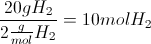
Now that we have the moles of hydrogen, we can use the molar ratio given in the equation of 1:3. Since we need 1/3 of the moles of hydrogen as nitrogen, we know we need 3.33 moles of nitrogen gas.

Now, we simply multiply the moles by the molar mass of nitrogen gas (28 grams per mol) and we find we need 93.33 grams of nitrogen gas.
