Operations with Fractions
Help Questions
SSAT Upper Level Quantitative › Operations with Fractions
Solve,


Explanation
Since the denominators for the fractions are the same, keep the denominator and add the numerators.


Explanation
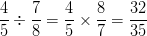
Turn the second fraction upside down to find its reciprocal, and then multiply the first fraction by the reciprocal of the second fraction to divide the two fractions. When multiplying fractions, you can multiply across, finding the products of the numbers being multiplied in the numerator and in the denominator.

Multiply these fractions:


Explanation
To multiply the fractions, simply multiply the numerators together and the denominators together.

Then simplify the fraction accordingly:

Multiply these fractions:
Explanation
To multiply the fractions, simply multiply the numerators together and the denominators together.
Then simplify the fraction accordingly:
Solve,
Explanation
Since the denominators for the fractions are the same, keep the denominator and add the numerators.
Explanation
Turn the second fraction upside down to find its reciprocal, and then multiply the first fraction by the reciprocal of the second fraction to divide the two fractions. When multiplying fractions, you can multiply across, finding the products of the numbers being multiplied in the numerator and in the denominator.
What is the result of this operation?


Explanation
Since the denominators are exactly the same, we can just subtract the tops.
So

By reducing we get

What is the result of this operation?
Explanation
Since the denominators are exactly the same, we can just subtract the tops.
So
By reducing we get


Explanation
Turn the second fraction upside down to find its reciprocal, and then multiply the first fraction by the reciprocal of the second fraction to divide the two fractions. When multiplying fractions, you can multiply across, finding the products of the numbers being multiplied in the numerator and in the denominator.
Multiply these fractions:


Explanation
To multiply the fractions, simply multiply the numerators together and the denominators together.

Since this fraction is in its simplest form, that is the final answer.